Passive Self-Compartmentalisation Array
Instrument-free sample partitioning and discrete volume metering via geometric capillary meniscus pinning.
| Material | 3D-printed polymer, optical tape |
| Method | Passive metering with differently sized capillary stop valves and air-plug isolation |
| Min feature | 100 µm capillary gap (250 µm wide) |
| Idea to tested device | 3 days |
THE WORKFLOW
Point-of-care diagnostics, digital PCR, and multi-replicate assays often require dividing a biological sample into uniform, isolated reaction volumes. Achieving this typically demands expensive instrumentation, active pneumatic manifolds, or complex elastomeric microvalves, which drive up consumable complexity and equipment unit costs.
HOW IT WAS BUILT
A serial 13-chamber consumable, fabricated by high-resolution SLA 3D printing and sealed with optical tape. Each chamber connects to the main distributor channel through a capillary stop valve. The valves differ in size, so each one holds or releases liquid at a different pressure. The narrowest is a 100 µm gap between the printed structure and the tape, 250 µm wide.
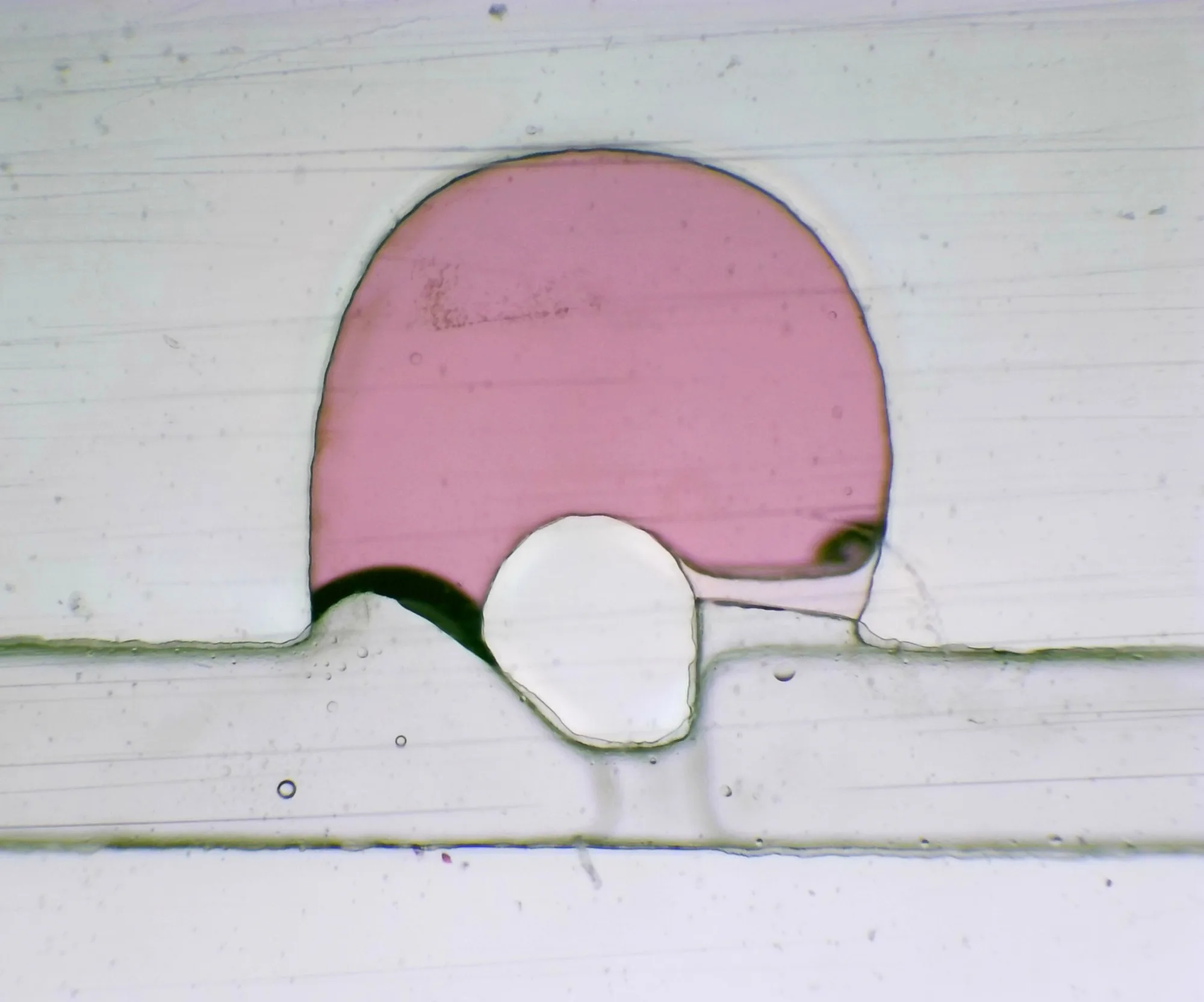 Micrograph of an isolated metering chamber: meniscus pinned at its capillary stop valve, with no cross-talk.
BENCH CHARACTERIZATION
Loaded with a standard laboratory pipette connected to the inlet through silicone tubing. A single loading step fills all 13 chambers in sequence. A trailing air plug then clears the main channel, while the stop valves hold the liquid in each chamber, isolating all 13 without cross-talk or leakage.
HOW THIS APPLIES TO YOUR DEVICE
If your diagnostic assay or digital reaction requires partitioning a sample into uniform, isolated micro-volumes, you do not need active pneumatic valves, pumps, or complex reader instruments. This geometric capillary logic can be customized for your specific chamber counts, nanoliter-to-microliter volumes, and biofluid surface tensions. By putting the fluidic control directly into the consumable geometry, your cartridge operates autonomously from a single pipetting step, significantly lowering your reader hardware cost and consumable failure points.